 PL
PL ENG
ENG RUS
RUS UA
UA
BlueTooth - board P120205
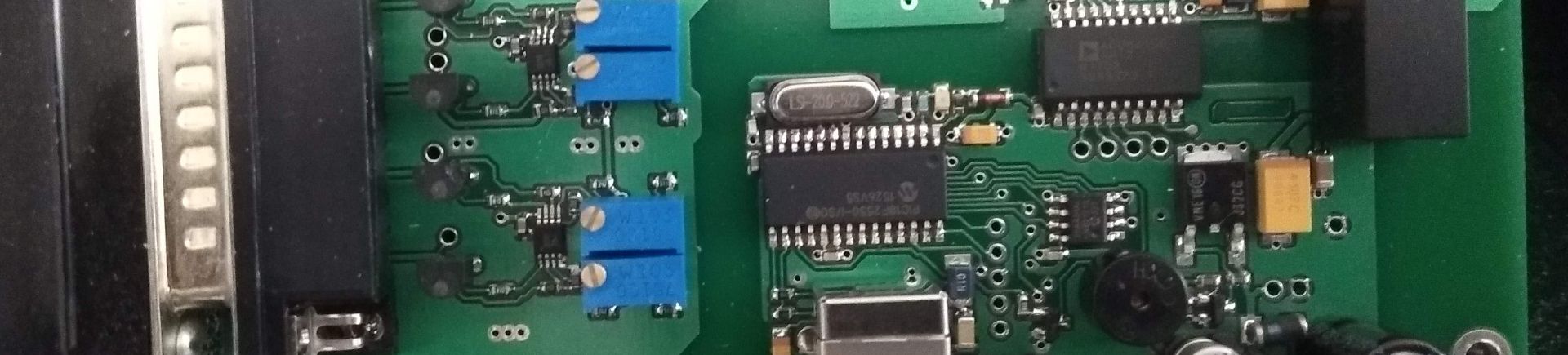
The P120205 board is intended mainly for devices with a UART interface, or for older equipment with an RS232 interface after minor modifications. It lets those interfaces be reached over a radio link using BlueTooth. The board carries a level converter, so both 5 V and 3.3 V signals can be connected. Its main component is a BTM222 module working in the BlueTooth class I standard. The board can be supplied with 3.3 V or with 4 V - 9 V, as it may contain a built-in regulator.
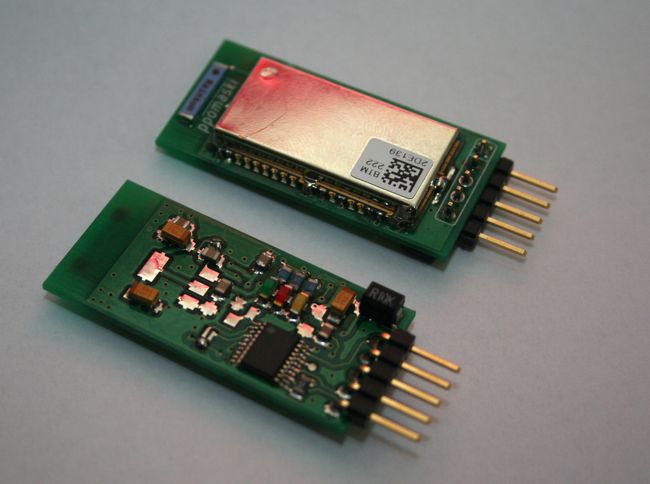
Fig. The P120205 boards
| Signals available on the goldpin header: |
| 1. | GND |
| 2. | TX |
| 3. | RX |
| 4. | VCC |
| 5. | RESET |
Example applications.
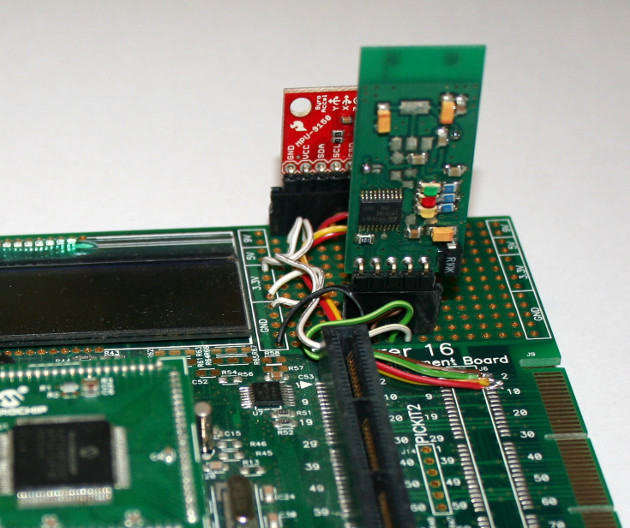
Fig. The Explorer 16 board with the P120205 module and the MPU-9150.
The board was used in a prototype device for recording selected environmental parameters. That prototype consisted of a Microchip Explorer 16 development board with a dsPIC33 processor, a Sparkfun MPU-9150 board carrying the MPU9150 chip, the successor of the MPU6050, and the P120205 board, which passed data and commands between the dsPIC processor and the computer.
Copyright ©2026 systemypomiarowe.pl.